Are You a She-oak?
Good novel writing takes time, and often it’s true that good writing is rewriting. Sometimes, though, the length of time it takes to complete a manuscript causes a writer to wonder whether their novel is worth writing.
I was discussing this issue with a writer friend. Both of us had spent the previous week worrying about whether we should ditch our novel and start again. But then I remembered the resilient she-oak.
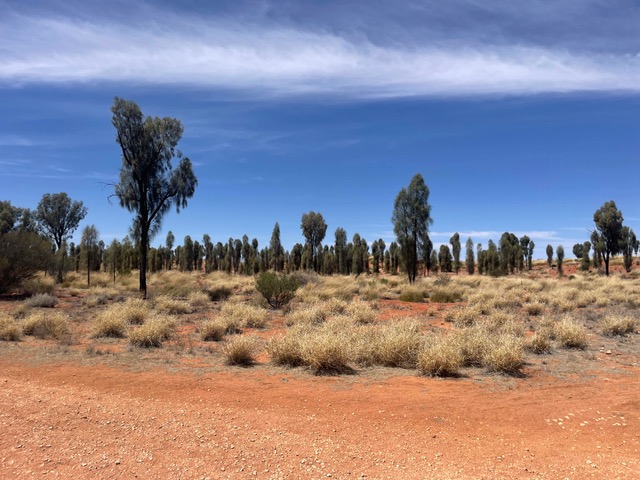
Recently, on a road trip to central Australia, travelling with my partner, I became interested in she-oaks. (Allocasuarina or desert oak are other names for this tree.) We had been driving along the Oodnadatta Track—600 kilometres of dirt road in South Australia—heading for Kati Thanda–Lake Eyre and had stopped to camp in a grove of she-oaks. That night I lay awake listening to the wind blow through the trees, astonished at the sound—so like the sound of ocean waves crashing on the shore.
As we continued on our journey, I kept noticing she-oaks. There would often be one or two larger trees and then twenty or so smaller ones nearby. I love these small trees. (They reminded us of Cousin Itt from The Addams Family.) I came to appreciate their resourcefulness. She-oaks nurture the environment around them. Animals and birds rely on them for food and shade. The seeds from the Black She-oak, the Salty She-oak, and the Drooping She-oak are vital to the survival of the Glossy Black-Cockatoo. (These birds are currently endangered and some councils are encouraging the regrowth of she-oaks as a potential solution.)
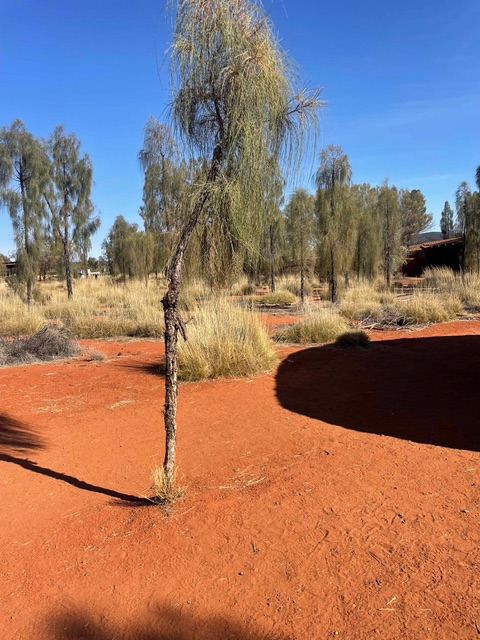
The she-oak, I realised, is an unappreciated tree.
Midway through the road trip, when I was in Alice Springs, I was told that she-oaks can remain small for years as they wait for the right conditions to flourish. But in fact, the she-oak is not waiting; it is working.
When the soil around the she-oak is nutrient-poor and the land is in drought, it remains active beneath the surface. It pours energy into the root system, sending taproots to search for water and forming symbiotic relationships with nitrogen-fixing bacteria that live in specialised nodules on the plant’s roots. Above-ground growth may seem stalled, but below-ground the she-oak is preparing for the future.
Some writers are like she-oaks.
A writer might take years to develop a creative project. In my case, it has usually been a novel or a play, but it could be a collection of short stories or poems, a screenplay, a long essay. To the outside world, it can look as though there is no work going on. The writer may be unsure of their own progress. I have certainly felt that many times. Yet I keep reminding myself that if the work is real, beneath what looks like stillness, there is activity.
In the initial stages of a project, writers will be doing many things: reading, writing fragments, following clues, looking for patterns. We may be writing beautifully, we may be writing badly, we may be writing in dot points. Or we may be drawing pictures, developing diagrams, doodling. We may abandon pages and pages of work, yet that work will inevitably have taught us something important about the project—something we may not have been able to learn elsewhere. Often, in the small she-oak stage, we are finding the voice for the project. That voice will not usually evolve fully formed on a craft level; the words and sentences may still be terrible to read, yet within them lies the energy for growth.
The small she-oak stage is labour without applause.
Yet if writers trust in the process, as the she-oak trusts in nature, and keep actively attending to the work, conditions gradually improve and the project’s voice develops. When the manuscript is completed and published, readers might say the novel came out of nowhere, but the author knows they were always doing the work beneath the surface—quietly, consistently, and out of the public eye.
Speed is not a necessary requirement for a healthy she-oak, and the same is true for a work of art.
So next time you have doubts about the slowness of the writing process, ask yourself: Am I a she-oak? If the answer is yes, trust in the work and continue on.
References
She-oaks are lovely ancient Australians (and nothing to do with oak trees)